ABOUT THIS ACCOUNT
Firsthand owner account, supplemented by dated correspondence and repair records. Dealer interactions and the calibration mismatch reflect the owner’s reported experience. How we document the build.
Record reviewed October 17, 2026.
A truck I kept losing confidence in
The frustrating part was being stuck in limp mode more than once. A check-engine light was not just a symbol on the dashboard: it meant another round of trying to understand what was wrong, asking for help and wondering whether the truck would behave normally again.
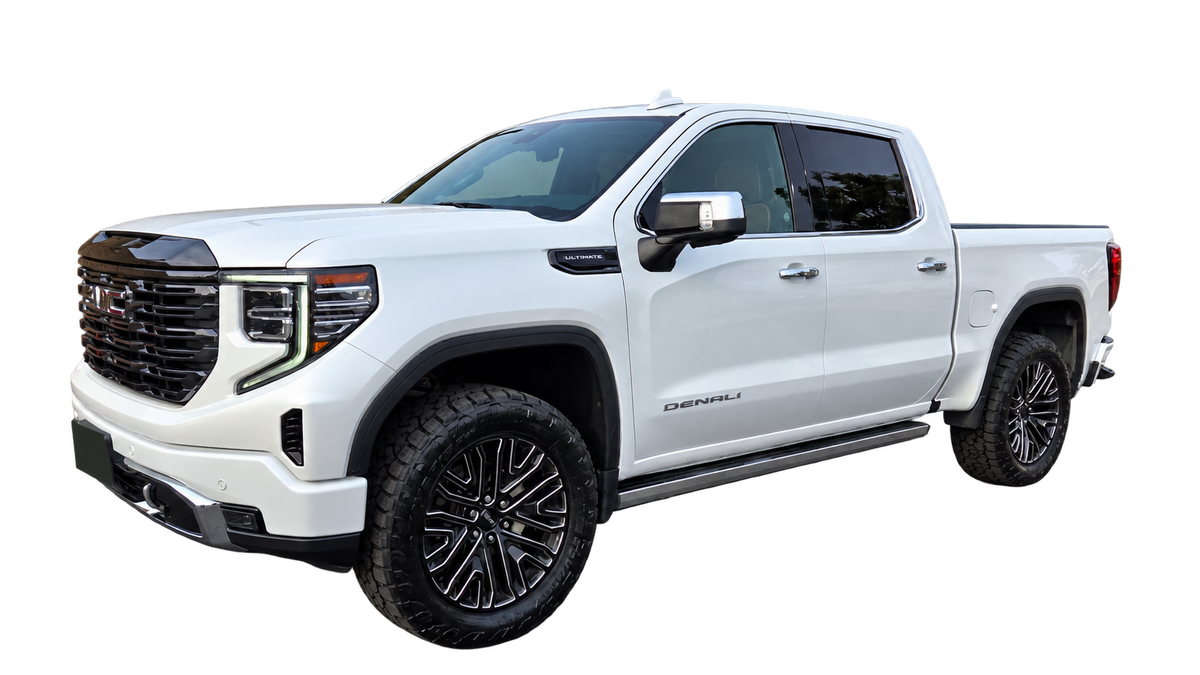
My truck is a refreshed 2022.5 Sierra Denali Ultimate with the 3.0L LM2. It had DuramaxTuner engine and transmission calibration before this repair. The later turbo-related trouble included a recurring P003A fault and reduced-power warnings. This was an ownership problem I needed resolved, rather than a project that began with a healthy turbo and a desire for a bigger horsepower number.
DuramaxTuner tried to help. The problem stayed.
I went back to DuramaxTuner during the fault episodes. They tried to help, but the exchange did not get me to a working resolution. Their response to the recurring fault was that they had not seen that code on the other 3.0L trucks they had tuned. From my side, I still had a truck with a problem and no useful answer to what would actually fix it.
That is separate from how the transmission tune felt. Earlier revisions had taken work, and by February 2026 I had praised the shifts as the smoothest the truck had ever had. I could like that driving behavior and still be frustrated that support was not resolving the check-engine and limp-mode issue.
The recurring turbo fault had also appeared before the February engine revision, and an earlier actuator replacement had not put it behind me. The sequence does not establish that the original tune caused the factory turbo to fail.
The dealer wanted $800 to put it back to stock
I also tried the GMC dealer route. My experience was that the dealer would not proceed with the truck because it was tuned, and wanted to charge me $800 to flash it to stock. I had already flashed it back to stock.
That was a particularly frustrating dead end: I was trying to get the fault diagnosed, while the conversation was still about paying to return the truck to a state I had already put it in. It added another obstacle without giving me the answer I needed.
This is my account of that dealer interaction. It is not a statement about every GMC dealer, a published GMC-wide policy or an independent finding about what software was on the truck at the dealer’s inspection.
Finding Black Widow Diesel changed the direction
Black Widow Diesel became the turning point. The shop diagnosed the original turbo as failed and needing replacement. That gave me a concrete mechanical repair to work from after the warnings, limp mode and unsuccessful support conversations.
The March repair correspondence and a stock-turbo replacement estimate belong to that stage of the story. An estimate is not what I ultimately paid for the upgraded build. I looked into the alternatives and found VSE’s turbo, choosing that route instead of simply replacing the factory unit with another stock one.
The VSE STG3 turbo and Fuel System Saver were shop-installed, with the S&B/PPE airflow setup documented around the same build. The turbo chapter follows the hardware decision, and the intake chapter explains the separate inlet and outlet parts.
The new turbo needed a matching calibration
Getting the new turbo installed was not the end of the story. I learned that the DuramaxTuner calibration I had was not compatible with my VSE turbo setup. I needed calibration that worked with the hardware now on the truck.
That is the important distinction in this build: first there was a failed factory turbo, then there was the task of getting the replacement combination working correctly. A replacement part and an existing tune were not automatically a matched setup.
I am describing my particular configuration and experience. I am not claiming that every DuramaxTuner file is incompatible with every aftermarket turbo, or that the private calibration files have been independently audited here. The earlier support reply did not identify a specific change from the product details I supplied; that did not amount to a working solution for me.
Getting the VSE files took follow-up
I ordered the refreshed-model VSE engine and transmission package on May 4. The configuration I supplied included the installed VSE turbo and Fuel System Saver, the S&B/PPE airflow parts, the lift and the 285/55R22 tires.
The delivery process had its own frustrations. I followed up repeatedly and reported in late May that the truck was waiting on files. VSE’s response said it had only recently received the controller reads or identification needed to finish and lock them. The correspondence includes both accounts; it does not establish exactly where each handoff went wrong or how much delay was avoidable.
Files arrived in late May, with further delivery and an apology in June. That wait belongs in an honest account of the experience, even though I was ultimately happy with the result.
The VSE tune finally brought the resolution
On June 10, I reported that flashing had gone successfully. On July 10, after putting some miles on the setup, I reported that it was working well and that I was very happy with the file.
My account now is more specific than a generic “the tune feels good”: getting the VSE tune with the VSE turbo finally resolved the recurring check-engine and limp-mode problem I had been dealing with. That was the result that mattered most.
This was a repair-and-calibration progression, not a controlled comparison between two tuners on identical hardware. I do not have dyno results, a measured fuel-economy gain or a towing comparison to attach to it. The outcome I can describe is the resolution of the recurring problem on my truck.
What I would carry into another build
The lesson is to keep the whole configuration together: the exact truck, installed hardware, current calibration and the fault history. Good shift feel and a successful file write are different things from resolving a recurring mechanical or calibration problem.
The engine controller, or ECM, and transmission controller, or TCM, also belong in the same conversation. VSE’s refreshed-model package describes coordinated engine and transmission calibration. DuramaxTuner’s development explanation discusses the relationship between shift behavior and engine power delivery. Neither catalog description is a diagnosis of a particular truck.
If you are researching the parts, start with the parts and fitment guide. My configuration is an ownership reference, not a universal cure for P003A. Current interface requirements and road-use approvals still need to match the exact setup; an order label alone does not establish them. Private tune files, identifiers and correspondence stay private.
Follow the system.
This component is one part of a connected build. Explore its neighbors to see the whole picture.
Find it on the truck ↗Parts & buying notes ↗