ABOUT THIS ACCOUNT
Owner experience and manufacturer descriptions are distinguished throughout. How we document the build.
Record reviewed October 17, 2026.
The tires on this truck
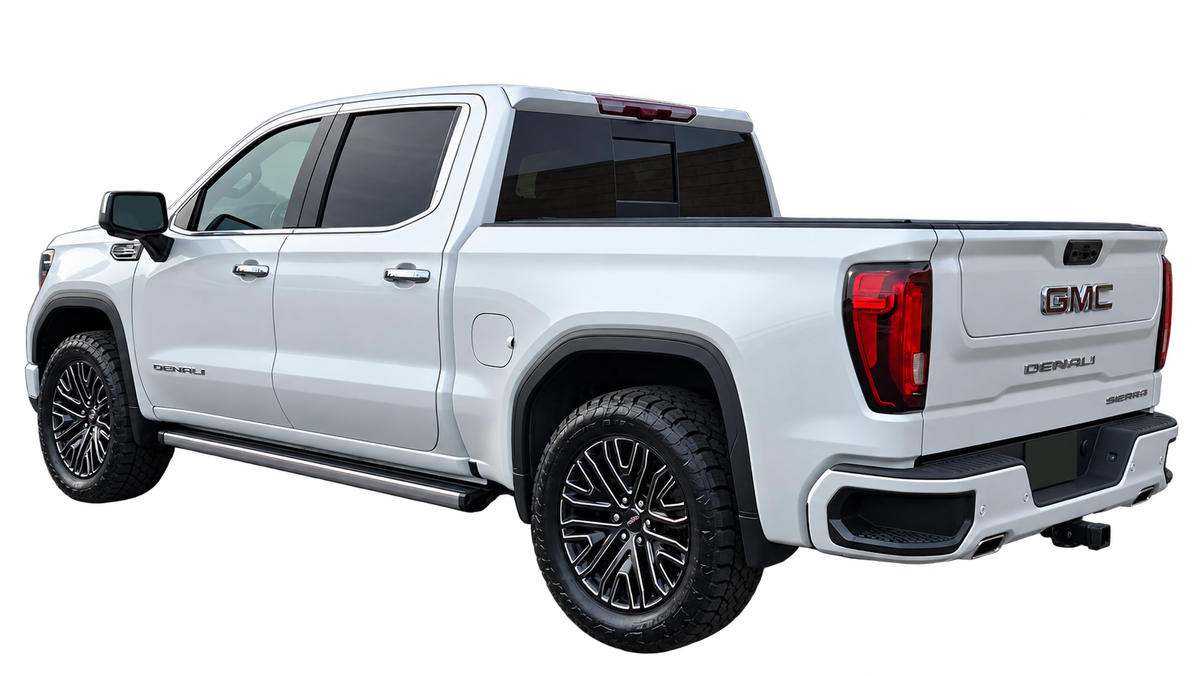
The recorded purchase is four Toyo Open Country A/T III tires in LT285/55R22, load range E, ordered in November 2025 and delivered in December. The owner later identified 275/50R22 as the previous size. The exact new model comes from the purchase record, rather than a guess based on the tread in a photograph.
Toyo positions the A/T III as an on-road and off-road all-terrain tire, with tread features aimed at wet and snow traction, including the three-peak mountain snowflake designation. Those are manufacturer descriptions; this truck does not yet have a documented snow test, noise comparison or long-distance wear assessment.
About 34.3 inches, on paper
The nominal code describes a 285 mm section width, a sidewall height equal to 55 percent of that width and a 22-inch wheel. Two sidewalls plus the wheel work out to about 34.3 inches in overall diameter. The same calculation for the owner-reported previous 275/50R22 size gives about 32.8 inches. That is roughly a 4.6 percent increase in nominal diameter.
These are calculations from the size markings, not mounted measurements. They explain the scale of the change without pretending to establish this truck’s actual rolling circumference, clearance or speedometer error.
The part the owner could feel
In February 2026, the owner told DuramaxTuner that the transmission shifts were excellent but the engine felt more conservative than desired. The larger tires were part of that account: the truck no longer had the same eager acceleration the owner remembered from the earlier setup. The request was for more immediate pedal and passing response while keeping smooth light-throttle driving.
A taller tire travels farther per revolution and changes the effective gearing at the road. Tire Rack’s sizing guidance explains why overall diameter matters to gearing and vehicle systems. That gives a plausible mechanical context for the impression, but does not prove how much of it came from diameter, tire mass, calibration or other conditions.
Why the size went to the tuner
The owner supplied the change from 275/50R22 to 285/55R22 when requesting a calibration revision in January, and supplied the new size again with the later VSE hardware inventory. The requests covered road-speed readings and transmission behavior.
As Tire Rack explains, taller tires cover more distance per rotation and can make a speedometer based on the original size read low. Providing the tuner with the size is useful; it is not independent verification of the final correction. No measured speedometer check has been recorded for this truck.
What the tire size cannot answer
The SuspensionMAXX setup is part of the fitment, but tire size alone cannot establish clearance at steering lock or through suspension movement. Wheel width and offset, any trimming, and alignment results still need documentation. There is no rub-free fitment claim here.
Load range E describes the tire’s load category; it does not raise the truck’s ratings or establish the right pressure for a particular load. Ride comfort, road noise, tread life and fuel economy remain owner-update subjects rather than assumed benefits of the larger tire.
Follow the system.
This component is one part of a connected build. Explore its neighbors to see the whole picture.
Find it on the truck ↗Parts & buying notes ↗